
How Much Does a Cat Dental Cleaning Cost? Why Resorptive Lesions Make Cats Different From Dogs
A cat dental cleaning quote that looks like a bargain next to a dog's dental estimate often turns into a bigger bill than expected once the vet actually opens the cat's mouth under anesthesia. The reason isn't sloppy estimating — it's a disease that is far more common in cats than dogs, hides below the gumline, and can't be diagnosed without dental X-rays. Understanding tooth resorption is the difference between budgeting $400 and budgeting $1,200 for the same cat.
The baseline: a cleaning with nothing else found
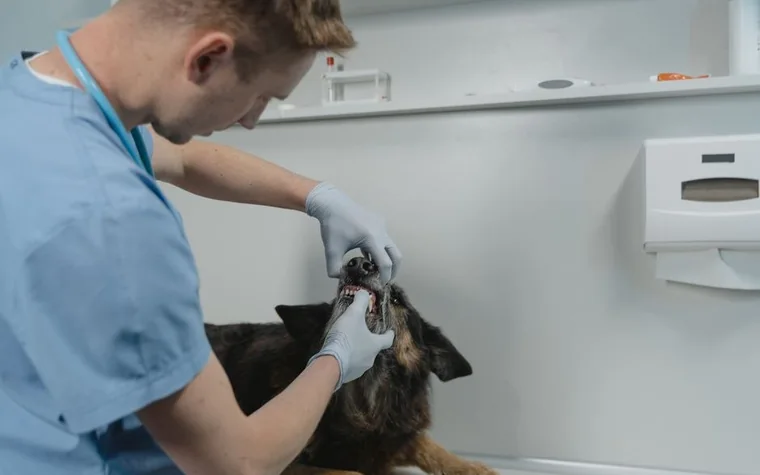
A routine cleaning — pre-anesthetic exam, anesthesia, ultrasonic scaling above and below the gumline, and polishing — runs roughly $400 to $700 at a general veterinary practice, with some clinics quoting as low as $250 for a young cat with minimal tartar. That baseline typically does not include dental X-rays or extractions. It assumes the cat's teeth are structurally sound once the tartar is removed, which for cats is the exception rather than the rule.
Why cats almost never stay at the baseline price
Feline tooth resorption — sometimes still called FORLs — is a condition where a cat's own body slowly dissolves the tooth structure, starting at or below the gumline. Studies estimate it affects somewhere between 20% and 60% of cats, and the range is wide partly because early lesions are invisible without imaging. A tooth can look completely normal at a glance and still be actively resorbing underneath. That single fact is why a cat's dental bill is so much harder to predict in advance than a dog's.
Full-mouth X-rays are not an upsell — they're the only way to see it
Veterinary dental guidelines call for full-mouth dental X-rays at every feline dental procedure, not just when a lesion is visible. Because resorption starts under the gumline, a cat can have several affected teeth that look fine to the naked eye. Skipping X-rays doesn't lower the real cost of the problem — it just means the disease goes undiagnosed and the cat is anesthetized again later to finally address it. Full-mouth X-rays commonly add $100 to $250 to the bill, and in a cat, that expense is doing more diagnostic work than the scaling itself.
Extractions: why cats need more of them than dogs
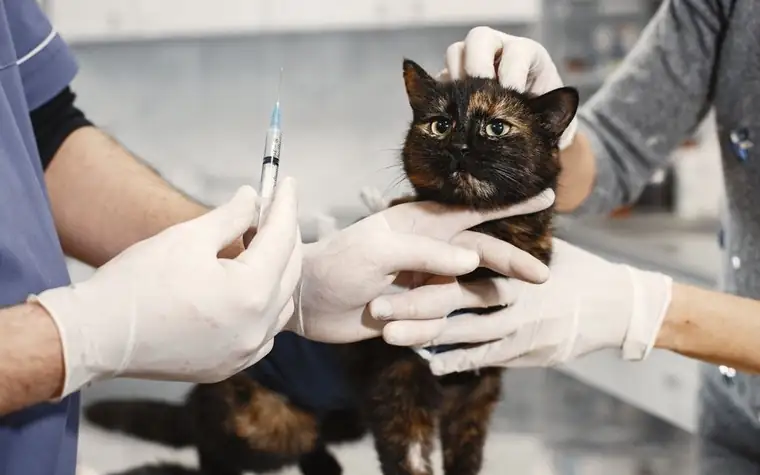
Once resorption is confirmed on X-ray, the standard treatment is extraction — there's no filling or root canal that reliably stops the process. A simple extraction runs $150 to $350 per tooth; a surgical extraction, needed when the tooth has fused with the jawbone (common in advanced resorption), runs $350 to $1,000 per tooth. Because resorption frequently affects several teeth at once rather than just one, a cat needing four to six extractions can add $1,000 to $1,500 on top of the baseline cleaning — which is how a $500 estimate becomes an $1,800 final bill.
The rest of the bill: smaller than a dog's, not by much
Pre-anesthetic bloodwork to confirm kidney and liver function before anesthesia runs $50 to $150, similar to the standard bloodwork panel priced separately. Anesthesia itself is usually cheaper for a cat than for a mid-size or large dog, commonly $150 to $300, simply because dosing scales with body weight. That smaller anesthesia line is often the only part of a cat's dental bill that is genuinely lower than a dog's — the X-ray and extraction costs frequently even out or exceed what a similarly tartar-covered dog would pay.
What actually separates a $400 visit from a $1,200 one
Three things move a cat's bill toward the high end: how many teeth show resorption on X-ray, whether any extractions turn out to be surgical rather than simple, and the cat's age, since resorption becomes more common later in life. A young cat with clean X-rays and no extractions can genuinely land near the $400–$700 baseline. An older cat is statistically more likely to need several extractions, which is one reason dental costs tend to climb as part of the broader pattern covered in the annual cost of owning a cat.
Why the pre-visit estimate is always a range, not a number
A clinic genuinely cannot tell you the final price before the cat is under anesthesia and the X-rays are taken — that's not evasiveness, it's how the disease works. The honest version of an estimate is a low number (cleaning only, nothing found) and a high number (multiple extractions), with the actual bill landing somewhere between depending on what the X-rays show. Asking the clinic for both numbers before the appointment, rather than a single quote, is the most useful question a cat owner can ask.
Cost checklist
1. Baseline cleaning — exam, anesthesia, scaling, polishing: $400–$700.
2. Pre-anesthetic bloodwork — $50–$150.
3. Full-mouth dental X-rays — $100–$250, and effectively mandatory given resorption prevalence.
4. Simple extraction — $150–$350 per tooth.
5. Surgical extraction — $350–$1,000 per tooth, needed when the tooth is fused to bone.
Total for a cat needing several extractions commonly lands between $800 and $1,800.
This article covers typical U.S. cost ranges for feline dental procedures and is not veterinary advice. It does not address diagnosis or treatment decisions for a specific cat — those belong to your veterinarian. Sources: published veterinary dental cost surveys and clinic rate cards; feline tooth resorption prevalence estimates from veterinary dentistry literature. Verified August 2026.
All content is fact-checked under our editorial standards.