
How Much Does IVDD (Disc Disease) Surgery Cost for a Dog? The MRI, the Hemilaminectomy, and Why Dachshunds Foot This Bill Most Often
Dachshunds have a 15.3% lifetime prevalence of intervertebral disc disease (IVDD) -- meaning roughly one in six will herniate a disc badly enough to need veterinary care, according to breed-risk data cited by veterinary neurology specialists. When it happens, owners are usually told two things in the same conversation: their dog needs an MRI before anyone can operate, and the surgery itself is not optional if they want their dog walking again. Here is what that bill actually looks like, step by step.

What IVDD actually is, and why it's an emergency
IVDD happens when the cushioning discs between spinal vertebrae harden, bulge, or rupture, pressing on the spinal cord. In small, long-backed breeds -- Dachshunds, French Bulldogs, Corgis, Beagles -- the discs degenerate early through a process called chondroid metaplasia, which is why IVDD shows up far more often in these breeds than in a Labrador of the same age. The window between "wobbly back legs" and "can't feel his feet at all" can be a matter of hours, and how fast an owner gets to a specialist changes the surgical outcome more than almost any other factor.
The MRI comes before the price quote
A surgeon can't safely operate without imaging, because a hemilaminectomy targets a specific disc space -- guessing wrong means operating on the wrong level and leaving the actual problem untouched. That imaging step, covered in more detail in this site's guide to pet MRI and CT scan costs, typically runs $1,500 to $3,500 on its own, since it requires general anesthesia and is usually billed separately from the surgery that follows on the same day or the next.
The surgery itself: $2,000 to $5,000
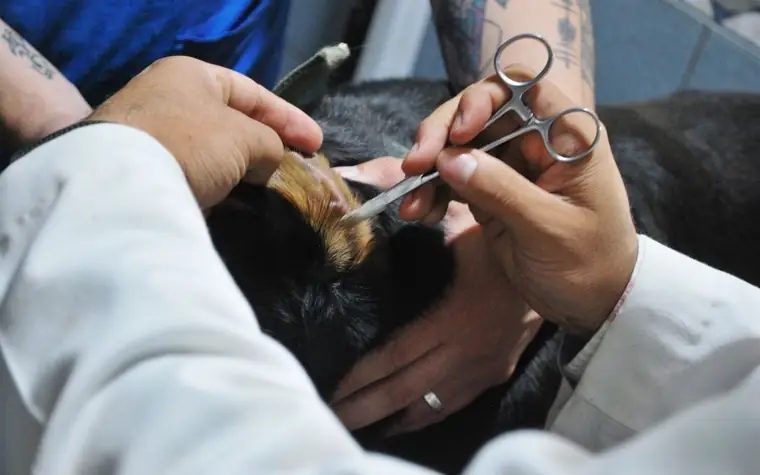
The hemilaminectomy -- removing a small window of bone from the spine to relieve pressure on the cord and retrieve the herniated disc material -- runs $2,000 to $5,000 on its own, according to cost data published by veterinary neurology practices in 2026. A straightforward single-level surgery in a small dog sits at the low end of that range; a large dog, a neck (cervical) disc instead of the more common lower-back location, multiple affected disc spaces, or a dog needing intensive post-op monitoring all push the number toward the top.
The all-in number owners actually pay
Add the MRI, anesthesia ($800 to $1,200), and hospitalization (commonly $200 to $600 per night for 2 to 5 nights of post-op monitoring) to the surgery fee, and most owners land at $5,000 to $10,000 for the full episode. Broader industry estimates put total IVDD treatment -- surgery plus the imaging and aftercare around it -- at $5,000 to $12,000, which lines up with what specialty neurology practices report. There is no version of this diagnosis where the surgery fee alone is the final bill.
Why the location and number of discs changes the price
Most IVDD surgery happens in the thoracolumbar spine (mid-to-lower back), which is both the most common site and the more straightforward of the two to access surgically. A cervical (neck) disc requires more delicate dissection around major blood vessels and nerves, which is why surgeons price it higher and monitor those dogs more closely afterward. Dogs with more than one compressed disc space sometimes need a longer procedure addressing multiple sites in the same surgery, which adds both operating time and anesthesia cost rather than simply doubling the single-disc price.
What happens if you skip surgery
Mild cases -- a dog still walking, just wobbly or reluctant to jump -- are sometimes managed conservatively with strict crate rest, anti-inflammatories, and pain control instead of surgery, and a portion of those dogs recover without an operation. But once a dog loses the ability to walk or loses deep pain sensation in the affected legs, conservative management has a far lower success rate, and the window to operate before nerve damage becomes permanent is measured in hours to a couple of days, not weeks. The anti-inflammatories and pain control used here overlap with the NSAID options this site covered in its guide to dog arthritis treatment costs, but a specialist's exam -- not a home wait-and-see approach -- is what determines which category a given dog falls into.
Where pet insurance does and doesn't help
If a policy was active and IVDD had never been diagnosed before enrollment, most accident-and-illness plans cover disc surgery as an eligible condition, subject to the deductible and reimbursement percentage. The complication is recurrence: IVDD is a degenerative condition, and a dog that herniates a second disc at a different spinal level after the first episode was already on record can run into the same kind of bilateral-style exclusion some insurers apply to paired joints -- treating the whole spine as one pre-existing condition rather than each disc as a new event. Reading the policy's definition of a "condition" before a second episode happens is worth the ten minutes it takes.
Before you book the surgery
Ask the specialist for an itemized estimate that separates the MRI, the surgery fee, anesthesia, and the expected hospitalization nights -- not one bundled number, since the hospitalization range alone can swing the total by $1,000 or more. Ask what the plan is if the MRI shows more than one affected disc, since that can change the quote after the imaging is already done. And because breed risk is the single biggest predictor here, an owner of a Dachshund, Corgi, or French Bulldog is better served asking a vet about early warning signs -- reluctance to jump, a hunched back, dragging a rear paw -- before an emergency trip forces the decision. This article covers cost and general information only, not veterinary advice; diagnosis and treatment decisions should come from your veterinarian or a board-certified veterinary neurologist.
All content is fact-checked under our editorial standards.